Through the Jungle

My journey to becoming a teacher

My teaching career began in a jungle. Not the concrete one full of noise and hustle but the literal jungle.  My classroom was on top of a hill that looked down upon thatched roofs, banana trees and limestone peaks dotted with dense foliage.  

Becoming a career teacher wasn’t something that I planned for or even expected, but through a series of choices as a young adult, it was a path that began to form and continues to twist and turn still today.  

When I was 23, I left all that I knew in the US to work as a volunteer English teacher in a refugee camp on the Thailand/Burma border.  I can’t say that I really understood what I was going to be doing nor was I educated as a teacher at this point. But I knew it was a chance I had to take. My best friend who was already working in another refugee camp assured me of this.

Over the coming 16 months in rural Thailand, I certainly found out what it meant to be a teacher and a teacher is what I decided I wanted to be.  My work seemed simple: help upgrade English levels for students, who were continuing their education after high school.  I had spoken and studied English my entire life.  Surely, I could find ways to help others learn my mother tongue. 

As I think about it now, it was of course anything but simple.  In some ways, it was down right ridiculous.  And it was what got me hooked on teaching.  The less direction there is and the more responsibility I have, the more intriguing I seem to find it, almost like it is a puzzle that has to be both created and solved.  There has to be a way to succeed, and you trust me to find the way. 

To get started I had to figure out what now, what next and why does it even matter, which are questions that continue to guide me today, but ones that left me vexed as I first stood in front of my first two classes of students.  

Those first days and weeks I started by reflecting back on experiences I had had in school that I felt were purposeful and used those as a compass to help guide me.  What was it that made school feel worthwhile?  The memories of former teachers, academic successes and trials flooded back and gave insights into what I should do and also what I shouldn’t. 

Analyzing the experiences that had had the greatest success, I could see some similarities between them that could at least help me get started.  I have since realized these similarities were core values – something that is rooted in all the learning I design whether it be for children or adults. 

  • Creativity: teachers who had engaged me well were creative in how they got us to learn.
  • Inquiry based: teachers shared the responsibility of learning with us and helped us build on what we knew. 
  • Relevant: teachers grounded the learning in the world around us and helped us understand why it even mattered.  
  • Social connection: teachers connected us through learning and made these experiences fun.   

Over the months, my students validated my conclusions with the feedback they gave on the work we were doing.  This way of teaching was different to what they knew, and it was working.  I ultimately realized that as the teacher, I had the power to take this understanding and apply it to all of my design.  I had the power to make learning more enjoyable and purposeful.  I had the power to make learning more meaningful and fun.  I had the power to reshape how people experience school. 

It was these realizations and validations that propelled me to pursue a career in education.  I could contribute to making a change.  Despite initially feeling like an imposter, I left the jungle not only knowing that I was a teacher but knowing my purpose. Now I just had to go back to school to make it official.
Our New, “New Education”

We are not only “the last…of an epoch,” we are more than that, or we are that in a different way to what is most often asserted. We are the first…of a Future that has not materialized.

-Wyndham Lewis

“I believe that education is a process of…living and not a preparation for future living.” I believe “to prepare him for…future life means to give him command of himself; it means so to train him that he will have the full and ready use of all his capacities.” “I believe finally, that education must be conceived as a continuing reconstruction of experience; that the process and the goal of education are one and the same thing.” In 1897 John Dewey penned these and other beliefs about education in his work My Pedagogical Creed. At this moment in history, society was beginning to undergo a monumental technological transformation; thus, Dewey believed it prudent that education change alongside society, dubbing this idea “New Education.”[1] Now more than 100 years on from these publications, our world is in the midst of another massive technological transformation, and we must once again expect education to evolve.  What do we believe education is in the 21st century? What is our “New Education?” 

 In a recent workshop, I propositioned participants with just this idea. Participants were asked to share a moment of teaching that they considered to be a “peak experience,” (a moment of teaching where they were in a state of flow alongside their students) to help reveal their beliefs about education. While anecdotes echoed around the room, the affective imprint the experiences left could easily be identified from the smiling faces and jovial gestures common to each group. As group members then identified beliefs embedded in the stories, words like creative, independent, and collaborative marked common threads between perfect strangers. Apparently, we do know what we believe about education, and many of our beliefs are shared. How then do these beliefs play a part in our day to day lives as teachers, and more importantly how do these shared beliefs become the basis for the creation of our new educational foundations?

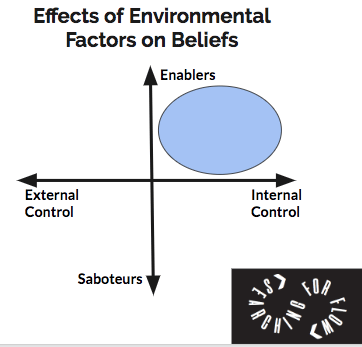
 Within any environment there are a variety of factors that influence the degree to which one is able to maintain the integrity of her beliefs. Schools are no different. There are factors that support and enable efforts to uphold beliefs while there are other factors that challenge or sabotage these efforts. There are internal factors within our control as educators and external factors we have no control over whatsoever. In order to define the core beliefs of our “New Education,” we must first consider two specific factors that are within our control and enable us to adhere to our beliefs: pedagogical philosophy and individual voice. 

The blue area represents the region of initial focus as we look to identify core beliefs in education.

1.    Pedagogical Philosophy

·    What are your beliefs about how learning should be designed? 

·    What is the role of the teacher? 

·    What is the role of the student?

·    What is the role of the parent? 

·    Who is asking the questions? 

·    Who is designing the process?

·    Who is in control of the learning, and how is this demonstrated?

2.    Individual Voice

·    How is individual voice recognized?

·    What opportunities do individuals have to influence the environment?

·    What opportunities do individuals have to influence the learning?

·    How does the balance of power feel to the individual?

·    What is the story the individual will tell about her educational experience?

By exploring our shared beliefs related to these two ideas, we can begin to lay cornerstones for our own pedagogical creed and initiate the construction of 21st century education. 

I believe education should be understood as a series of experiences and that each experience uniquely impacts an individual’s understanding and perception of self. I believe each student has the capacity to be an agent of her own learning and the role of the teacher is to foster the understanding of this potential. I believe society needs to redefine its beliefs and values related to education and recognize that this starts with the individual. How about you, what do you believe?

[1] Dewey, John. The School and Society: Being Three Lectures. 1899. Print.